B12: The AI Website Builder Redefining Professional Services Automation
Ravi Chen
February 18, 2026
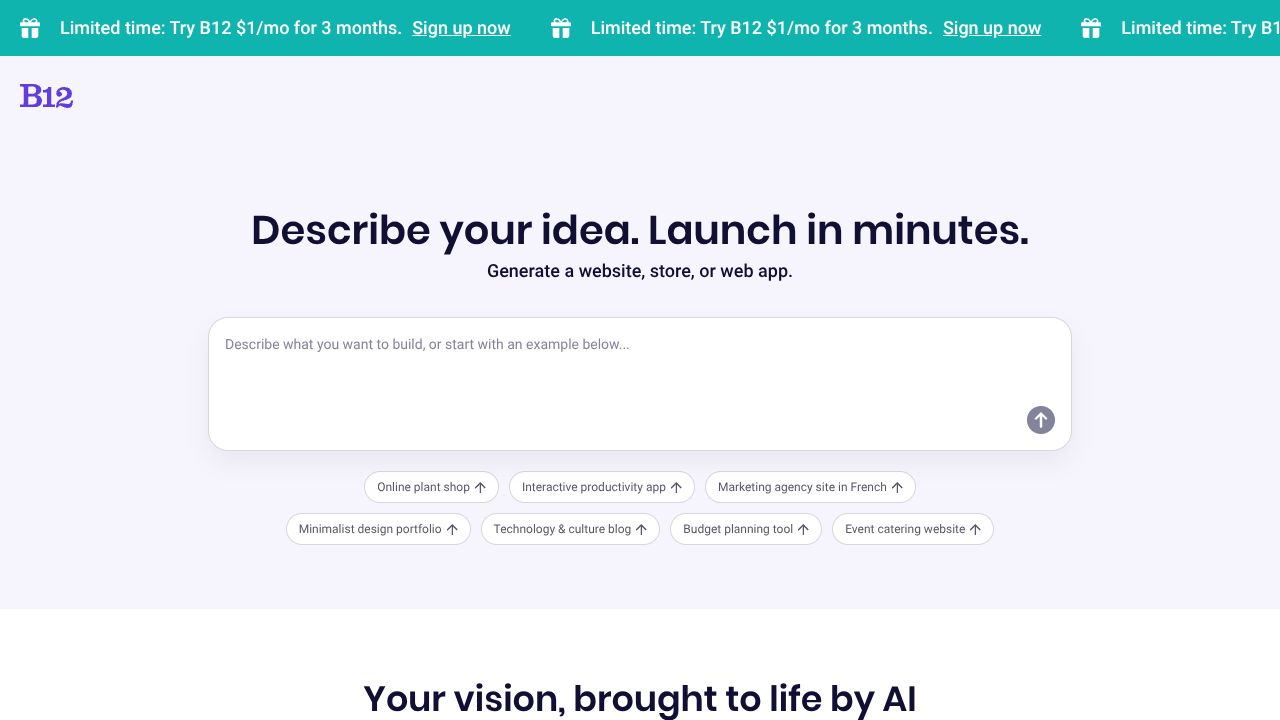
Most page builders promise speed — B12 promises search traffic out of the box
In my 15 years watching SaaS tooling, I’ve seen a thousand site builders that give you pretty pages and leave the SEO to chance. B12 is contrarian: it generates complete, publishable landing pages with SEO baked into the generation loop so a service business can spin up an SEO-ready site in minutes. Technically, that means an AI content generator paired with a rules-driven SEO engine, templates tailored to service verticals, and a one-click publishing pipeline. From what I’ve seen in this category, the product design favors deterministic SEO outputs over pure “creative” copy — a pro for businesses that measure success in organic leads, not just aesthetics.
How B12 likely wires things together
B12’s product behavior points to a hybrid architecture: an LLM-driven content layer + a template/rendering engine + a deployment/hosting layer. Practically that looks like:
- ◆Content generation: prompts + domain-specific templates produce semantic HTML, metadata, and structured data (JSON-LD).
- ◆SEO engine: a ruleset that injects keyword-optimized titles, meta descriptions, H1/H2 hierarchy, canonical tags, and schema (LocalBusiness, Service) during generation.
- ◆CMS/publishing: lightweight content management with immediate publish to a managed hosting stack and CDN, plus domain mapping and SSL provisioning.
Scalability is handled by separating the compute-heavy generation (likely serverless or worker-based LLM calls) from the static output delivery (CDN + edge caching). That split lets B12 serve many tiny landing pages cheaply while keeping generation burst-capable for onboarding spikes.
Feature Breakdown
Core Capabilities
- ◆Complete AI page generation: The engine produces full pages — copy blocks, images, navigation, and microcopy. Use case: a local electrician gets a ready-to-publish “Electrician in Austin” landing page with service sections and CTAs without writing a word.
- ◆Native SEO optimization: The pipeline auto-populates meta tags, H1/H2 structure, internal linking suggestions, canonicalization, and JSON-LD schema for local businesses. Use case: the same electrician’s page arrives with schema that helps Google surface business details and service offerings in rich results.
- ◆Service business templates & easy publishing: Templates target vertical-specific intent (plumbers, accountants, salons) with pre-populated service pages and pricing sections. Use case: a freelance photographer can publish a booking page with contact form integration and mapped custom domain within minutes.
Integration Ecosystem
B12 is built for low-friction operations: integrations usually include Google Search Console / Analytics, simple CRM webhook support, and connector platforms like Zapier for lead routing. For developers, expected hooks are publishing webhooks and script embedding for analytics or chat. That mix supports both “no-code” business owners and small engineering teams that want to pipe leads into HubSpot or a custom endpoint.
Security & Compliance
Site delivery will use HTTPS/TLS via automated cert provisioning. Data-in-transit is handled by standard TLS; data-at-rest practices are less visible publicly. For regulated customers, ask about data residency and backups — many vendors in this niche provide role-based access, two-factor auth, and routine backups, but enterprise-grade certifications (SOC 2, ISO) are not guaranteed for all small CMS/AI vendors.
Performance Considerations
Because outputs are static or edge-cached pages, runtime performance is good: low TTFB, fast LCP, and predictable resource use. The bottleneck is generation time during creation (LLM latency), not delivery. Expect sub-second page loads for published pages and 2–10 second waits during AI page generation depending on model and concurrency.
How It Compares Technically
Compared to heavier visual builders and headless CMS options, B12 trades deep developer control for rapid, SEO-focused outputs.
- ◆Webflow (https://webflow.com) — far more granular design control and a stronger dev export/workflow but requires manual SEO work.
- ◆Wix (https://wix.com) — similar all-in-one hosting and templates; Wix’s SEO tooling is robust but less automated in generation.
- ◆Framer (https://framer.com) — greater design fidelity and dev integrations; not centered on auto-generated SEO.
Those comparisons matter when you choose between automated SEO-first pages (B12) and platforms where SEO is an add-on to design.
Developer Experience
B12 skews toward builders and operators, not full dev platforms. Expect limited SDKs, minimal headless APIs, but practical developer surfaces: custom code blocks, script injection, and webhooks. Documentation is oriented to business setup and publishing workflows; deep API references are usually concise rather than exhaustive. Community and marketplace support will be smaller than Webflow or Wix but focused on service businesses.
Technical Verdict
Strengths: fast time-to-live for SEO-ready landing pages, template-driven domain intent, and efficient static delivery via CDN. Limitations: less flexibility for complex, bespoke frontends and limited enterprise-grade observability or headless APIs compared with dedicated headless CMSs. Ideal use case: small-to-medium service businesses or agencies that need predictable organic performance quickly. What others won’t tell you: if your long-term plan demands complex integrations, multi-channel content workflows, or advanced A/B experimentation, you’ll outgrow this class of tool and should plan an export/migration path early. In vertical SaaS terms, B12 is the pragmatic choice when SEO lead velocity matters more than pixel-perfect custom UI.