Can AI Really Predict Who Will Win Construction Bids?
Ravi Chen
March 1, 2026
Preconstruction as a Profit Center: Why This Changes the Math
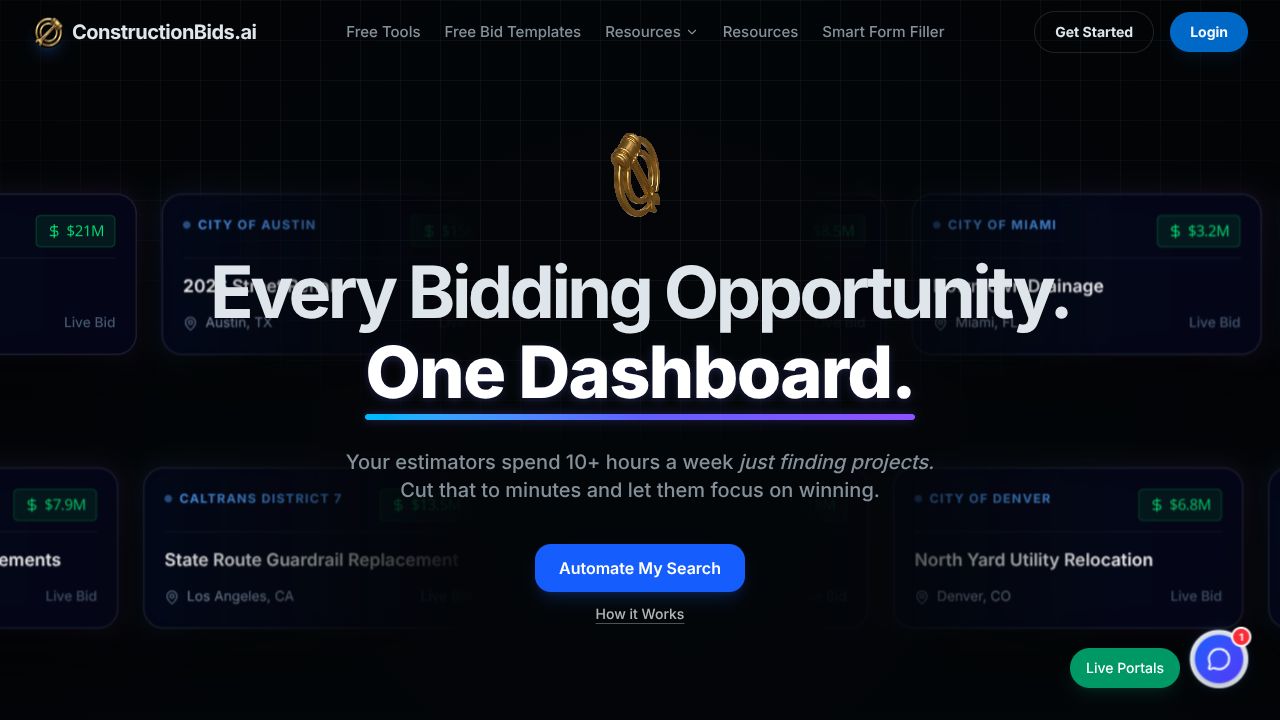
Picture this: it’s 7:00 a.m., your estimator is drowning in bid invites, guessing which five deserve attention. In my 15 years around construction tech, margins are won or lost here—before a takeoff even starts. ConstructionBids.ai applies AI to surface the right bids, score win probability, and ground estimates in historical costs—so small contractors chase fewer, higher-likelihood projects. At $49/month, the bottom line is better pipeline quality, less waste, and faster go/no-go calls.
The Business Case
Bid selection is a leverage point most leaders underinvest in. ConstructionBids.ai tackles the upstream problem—what to bid—before teams burn hours on estimates that were unwinnable from the start. For a small contractor submitting 8–12 bids per month, the rough economics are compelling. Assume an estimator’s fully loaded cost at $60/hour. If AI bid matching and probability scoring eliminate 8–12 hours of dead-end estimating monthly, that’s $480–$720 saved—before considering improved win rates. Now model a 2-point lift in win rate on a $4M annual bid volume at a 12% gross margin: ~$9.6k incremental gross profit. Even if you chop that in half for conservatism, you’re still paying back the $49/month subscription 50–100x.
Strategically, pairing discovery with estimating closes the loop: fewer blind spots, faster proposals, and tighter pricing discipline via a historical cost database. It positions small contractors to act like disciplined GCs without enterprise overhead—moving preconstruction from reactive firefighting to a repeatable, data-backed pipeline. In a market where schedule risk and material volatility punish imprecision, this is a quiet but real competitive edge.
Key Strategic Benefits
- ◆
Operational Efficiency:
AI bid matching focuses estimators on high-probability opportunities; proposal generation compresses turnaround time. The native mobile app keeps field and office synced on go/no-go decisions and scope clarity without email ping-pong. - ◆
Cost Impact:
Historical cost intelligence reduces underbidding and cushions against material volatility by anchoring estimates in real data. Win probability scoring cuts wasted estimating cycles on long-shot RFPs, reallocating capacity to jobs you can actually win. - ◆
Scalability:
Codified bid selection criteria and reusable cost libraries turn tribal knowledge into an institutional asset. As volume grows, leaders can scale pipeline without linear headcount growth—especially valuable for regional expansion plays. - ◆
Risk Factors:
AI scoring is only as good as the data—garbage in, garbage out. Small datasets, fast-changing commodity prices, or atypical scopes can skew predictions; leadership should monitor calibration, set thresholds, and require human override on edge cases.
Implementation Considerations
Treat this like a preconstruction operations upgrade, not “yet another tool.” Week 1: define your go/no-go rubric (trade, geography, project size, owner type) and baseline metrics—time-to-qualify, bids submitted, hit rate, estimate hours per bid. Weeks 2–3: import historical cost data and past bids (even simple CSVs) to seed the model; audit outliers so the AI doesn’t learn from anomalies. Week 3–4: run a controlled pilot with one estimator and one project manager across a single trade/geography. Instrument KPIs: qualified opportunities per week, proposal cycle time, and win-probability calibration (predicted vs. actual).
Change management is light compared to enterprise platforms: the mobile app accelerates adoption for field-aware decisions. Still, schedule two short enablement sessions—bid triage workflow and proposal generation handoffs. Integration is optional; start standalone. If you maintain cost data in spreadsheets or accounting, establish a monthly refresh ritual to keep historical costs current and the model honest.
Competitive Landscape
While Smartvid.io excels at AI-driven safety and risk analytics from jobsite imagery—reducing incident rates and insurance exposure—ConstructionBids.ai is better suited for the preconstruction funnel, prioritizing which bids to pursue and how to price them. Buildots transforms site progress into analytics for schedule and quality control; it shines post-award. In contrast, ConstructionBids.ai tackles the earlier, often-neglected decision layer: bid discovery plus estimating in one motion. Speak Ai is useful for analyzing and transcribing meetings or calls, but it’s a horizontal tool; it won’t score bid likelihood or tie directly into cost histories.
On pricing and accessibility, ConstructionBids.ai’s $49/month is a clear advantage for small contractors; Smartvid.io and Buildots are typically enterprise-oriented and require deeper data pipelines. If your immediate pain is “Which bids should we chase?” ConstructionBids.ai is the fit-for-purpose answer.
Recommendation
Pilot ConstructionBids.ai for 60 days with a single estimator. Actions: 1) Import 12–24 months of historical costs and past bids, 2) Set explicit go/no-go thresholds and target win-rate lift (+2 pts), 3) Track cycle time, estimate hours per won job, and margin variance, 4) Review AI scoring calibration weekly. If you achieve >10 hours/month saved and measurable lift in qualified wins, standardize across trades; if not, refine data inputs or sunset quickly. This is a low-cost, high-optionality bet worth placing.