Viraly: A Complete Guide for SaaS Professionals
Ravi Chen
March 1, 2026
Most schedulers make your content feel new — by forcing you to rebuild it. Viraly takes the opposite approach.
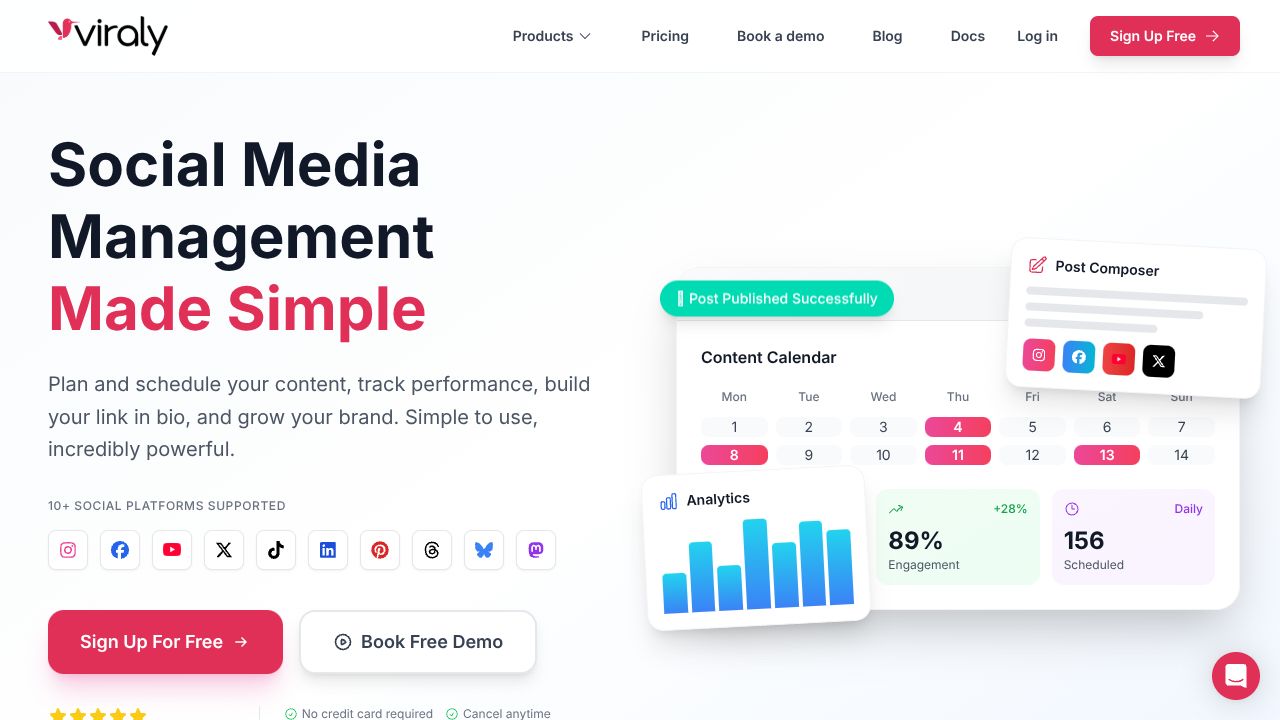
Viraly is a modern social scheduler built around calendar-based planning and remarkably strong content recycling—designed to keep your best posts working over time instead of chasing constant newness. It matters because for resource-constrained marketing and community teams, recycling plus auto-publish equals sustained reach with far lower production cost. Bottom line: if your objective is steady, measurable distribution from a lean team, Viraly is worth piloting.
The Business Case
In my 15 years in SaaS I’ve seen two consistent economic levers: reduce the cost of distribution, or raise the return on content investment. Viraly targets the first while improving the second. Its standout content-recycling engine turns evergreen assets into recurring distribution without manual resharing—this converts one high-quality piece of content into a predictable publishing stream, improving content ROI and lowering marginal cost per engagement.
For SaaS leaders, that translates into clear operational and financial outcomes: fewer hours spent on content scheduling, reduced demand on creative cycles, and improved channel continuity (which keeps leads flowing into top-of-funnel). The pricing (plans from ~$19/month and a free trial) makes it low-risk to test, particularly compared with higher-cost enterprise schedulers. From what I’ve seen in vertical SaaS teams, even modest efficiency gains—like halving the time spent on scheduling—free up budget to invest in targeted acquisition or product-led growth experiments. What others won’t tell you: recycling isn’t just a productivity hack—when done correctly, it stabilizes signal for algorithms and human audiences, creating compounding engagement effects that many teams underestimate.
Key Strategic Benefits
- ◆Operational Efficiency: Viraly replaces ad hoc spreadsheets and manual queues with a calendar-centric workflow and reusable content pools. That reduces context switching and lowers the day-to-day time cost of social programs.
- ◆Cost Impact: Affordable plans and automation reduce headcount pressure on social ops and community roles; the practical outcome is redeploying effort into higher-value activities (campaigns, paid experiments). For smaller teams, this can delay hiring one FTE.
- ◆Scalability: The platform scales horizontally by increasing the cadence of recycled content and vertically by adding channels—so growth is driven by reuse, not linear content production. It's a multiplier on existing assets rather than a drain that requires new inputs.
- ◆Risk Factors: Over-recycling risks audience fatigue if cadence and creative variation aren’t managed; governance and clear archival rules are necessary. Also, deeper enterprise needs (CRM sync, advanced automation) may expose feature gaps.
Implementation Considerations
Plan for a 4–8 week pilot: week 1–2 to map content pools and set cadence rules in the calendar; week 3 for integrating accounts and testing auto-publishing; week 4–8 for measurement and iteration. Resources: 1 marketing lead (owner), a part-time creative/repurposing resource, and IT support for account integrations. Change management is light but requires governance—define reuse policies, cadence thresholds, and audience exclusions up front to avoid overexposure.
Integration-wise, Viraly covers the primary platforms with direct scheduling; confirm channel support for your stack and whether you need API-level connections to CRM or analytics. If you track content-to-revenue attribution, plan a lightweight data handoff (UTM, CRM tagging) early. Success metrics should include time saved (hours/week), posts recycled, engagement per recycled post, and pipeline influenced over a 90-day window.
Competitive Landscape
While Origami Agents excels at building flexible AI agents for complex sales automation and conditional workflows, Viraly is better suited for marketing teams focused on straightforward distribution and reuse—no low-code automation design required. Sked Social leans Instagram-first with AI optimization and stronger creator-oriented tools for Meta/TikTok; it’s preferable if your execution is heavily visual and platform-specific. Meanwhile, Creatio is a low-code automation/CRM powerhouse fit for enterprise process automation—its strength is end-to-end workflow orchestration, not lightweight, affordable social recycling. Viraly’s differentiator is simplicity-plus-reuse at price points that de-risk trials for SMB and mid-market teams; its weakness is fewer advanced automation and CRM-native features compared to enterprise platforms.
Recommendation
If you run or advise a SaaS marketing org, run a time-boxed pilot with Viraly: 6–8 weeks, owned by demand gen, focused on repurposing three top-performing assets into recycled calendar campaigns. Track hours saved, engagement lift, and pipeline influence. If the pilot shows material time savings and stable engagement, fold Viraly into your distribution stack and reallocate saved budget toward acquisition or product-led experiments. If you require deep CRM automation, use Viraly for content ops alongside an automation platform (e.g., Origami Agents or Creatio) for attribution and complex workflows. For vertical SaaS leaders, this is a small, high-leverage operational bet with tangible ROI potential—test it fast and measure objectively.